
THE WORLDS FINEST SHIP, ALSO KNOWN AS HOME
the electric ship
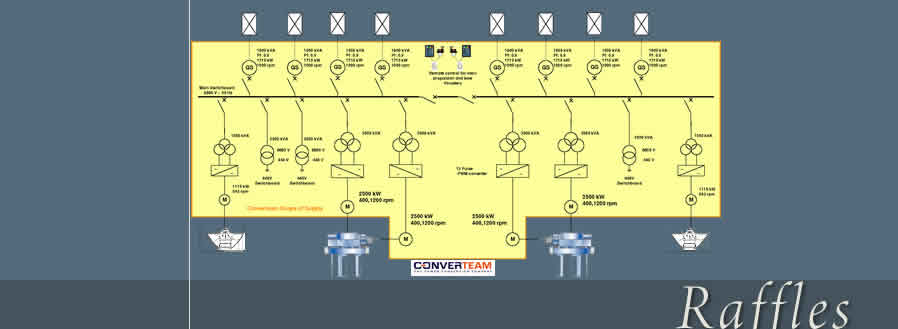
Raffles is an “all electric” ship meaning that it does not have conventional machinery arrangements, with a single or two main engines mechanically driving propellers and separate power generation for ships use.
Rather, its only power source are eight ABC Diesel 8 cylinder in line 1,000rpm diesel engines driving Converteam alternators producing in total about 13,000KW of medium and low voltage electrical power for all uses, including a maximum 7,600KW used for all full speed propulsion purposes.

The 8 alternator engines are from ABC Diesel, model 8DZC, @ 1,000rpm; 1,600KW. This design has been in service, since 1985 with ABC continuously building engines since licensed by Rudolph Diesel in 1899
With Raffles stopped 3 weeks out of 4 this means that it is not carrying around expensive machinery that is under utilised but that still has to be maintained.
While an “electric” ship is more expensive initially than a conventional (propulsion) system the advantages it offers far outweigh this and in the long term the additional cost is easily recovered from fuel savings, with this further enhanced by operation on less expensive heavy fuel oil (HFO) and not diesel.
Being all electric also means that it is virtually impossible for Raffles ever to be totally stopped or unable to manoeuvre due to mechanical breakdown. With 8 generators and 4 electric propulsors, only 1 of each needs to be operational for Raffles to be able to manoeuvre and continue her voyage or “safe return to port” (see Lloyd’s Register notations PSMR).
Being electric also has number of other advantages / benefits amongst them:
- Reduction or elimination of most noise and vibration. Raffles is a very quiet ship.
- Design flexibility with Raffles two power stations / machinery spaces located exactly where they have to be and propulsors positioned to maximise efficiency.
- Ease of maintenance with it possible to provide for continuous maintenance / repair without stopping or taking Raffles out of service. In addition 95% of maintenance is by the ships engineers and carried out in situ, typically by exchange and using the ships own workshops.
- Design growth with it being easy to add new equipment whenever, and practically anywhere in Raffles, it may be needed.
- Economy of operation with only the power actually needed at any one time generated.
- In the future having the option to change the motive source of power and / or fuels used.
- Safety, with electric driven auxiliary equipment typically more reliable and easier to monitor remotely.
Monitoring the operation of Raffles is a continuous task at sea or in port. This is achieved from a state of art central control room located on two levels between the main generator spaces. This additionally performs the function of an emergency centre able to also monitor most spaces and all machinery electronically and by CCTV. The control room also has full back up control of the ships steering / navigation including its own GPS, radar system, low light 360o TV positioned on the stack, as well as full off ship (satellite) communications systems. The control room is manned 24-7 even in port.